


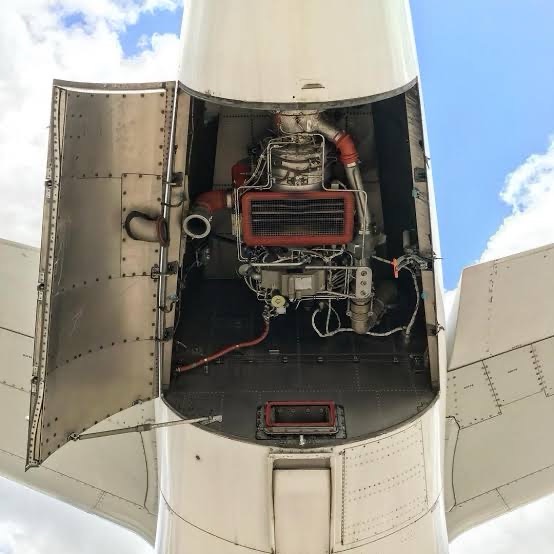
The Auxiliary Power Unit (APU) installed on the Airbus A320 family is a self-contained gas turbine engine mounted in the aircraft tail cone. Its primary function is to supply electrical power and pneumatic air to the aircraft when the main engines are not operating and, when required, to supplement these systems during flight. The A320 APU significantly enhances operational flexibility by allowing independent ground operations without reliance on external power or air sources.
On most A320 aircraft, the APU is the APS3200 series manufactured by Pratt & Whitney Canada, and it is fully integrated into the aircraft systems architecture designed by Airbus.
General Description of the APU
The APU is a single-shaft, constant-speed gas turbine engine. Unlike the main engines, it produces no thrust. Instead, the mechanical energy generated by the turbine is used to drive an electrical generator and a load compressor. The electrical generator supplies AC electrical power, while the load compressor provides compressed air (bleed air) for air conditioning, pressurization, and engine starting.
The APU consists of three main sections:
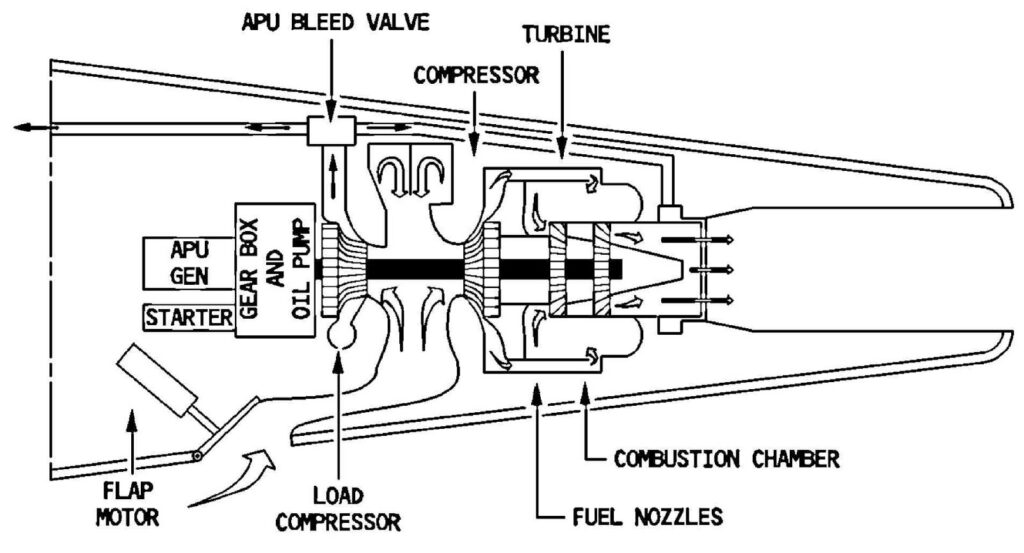
- Air intake and compressor section
- Combustion and turbine section
- Accessory gearbox and generator section
All APU functions are managed automatically by an electronic control system, requiring minimal pilot input and providing extensive built-in protection.
APU Control and Monitoring
The APU is controlled from the APU panel on the overhead panel using two primary controls: the MASTER SW and the START pushbutton. When the MASTER SW is selected ON, the APU Electronic Control Box (ECB) becomes active. The ECB performs a self-test, powers internal systems, and commands the APU air intake flap to open. This flap ensures adequate airflow to the APU during operation.
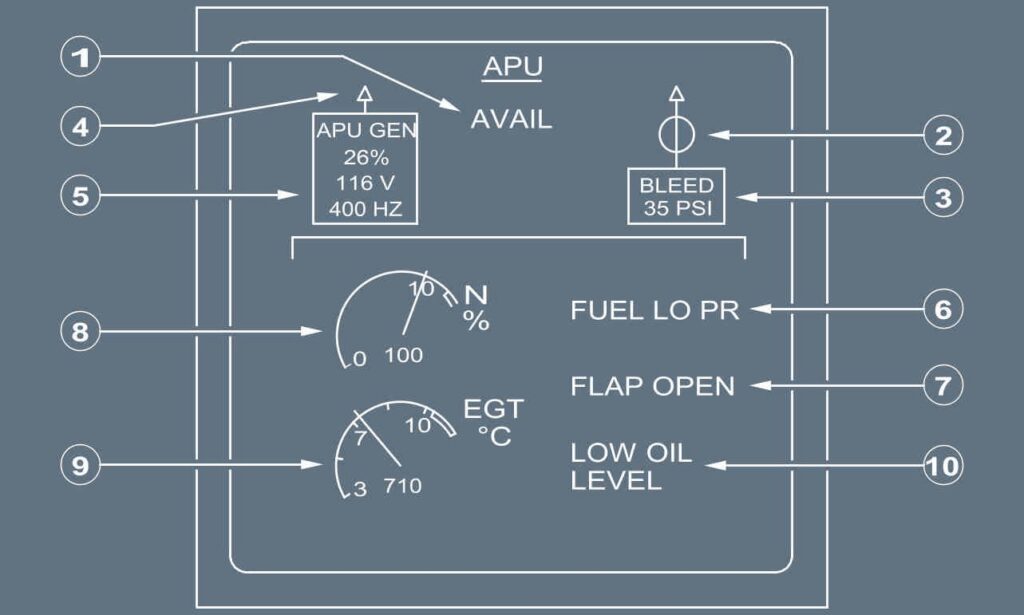
System indications, including APU speed (N), exhaust gas temperature (EGT), and generator status, are displayed on the ECAM system. The crew does not manually control fuel flow, ignition, or acceleration; all these functions are handled automatically by the ECB.
APU Starting Sequence
The APU start sequence on the A320 is fully automatic and follows a clearly defined logic. Once the MASTER SW is ON and the START pushbutton is pressed, the ECB initiates the start sequence using electrical power from the aircraft batteries or external power, if available.
Electrical power is supplied to the APU starter motor, which begins rotating the APU shaft. As the APU accelerates and reaches a predetermined speed, the ECB commands fuel introduction and ignition. Fuel is sprayed into the combustion chamber and ignited, allowing the APU to accelerate further under its own power.
As combustion stabilizes, the APU continues to accelerate until it reaches its governed operating speed, typically close to 100% APU speed. During this phase, the ECB continuously monitors parameters such as EGT, acceleration rate, and oil pressure to ensure the start remains within limits. If abnormal conditions are detected, the ECB automatically aborts the start to protect the unit.
APU Electrical Power Generation
Once the APU reaches stable operating speed, the APU generator becomes available. The generator produces 115 V AC, 400 Hz electrical power, identical in quality to that supplied by the engine-driven generators. When selected, APU power can supply the entire aircraft electrical system on the ground and, if required, in flight.
The electrical system logic prioritizes power sources automatically. If APU power is available and selected, it can replace external power or engine generators. The transition between power sources is automatic and designed to be seamless, preventing electrical interruptions to aircraft systems.
The APU generator is especially critical during ground operations, allowing cockpit preparation, avionics operation, cabin conditioning, and passenger boarding without running the main engines.
APU Pneumatic (Bleed Air) Supply
In addition to electrical power, the APU provides pneumatic air through its load compressor. This compressed air is routed into the aircraft pneumatic system when the APU BLEED valve is selected ON.
APU bleed air serves several purposes:
· Supplying air conditioning packs on the ground
· Providing air for aircraft pressurization
· Starting the main engines
During engine start, APU bleed air is directed to the engine air turbine starters. The high-pressure air spins the starter, which in turn rotates the engine core until fuel and ignition are introduced.
The ECB and aircraft pneumatic system logic ensure that APU bleed air supply is automatically regulated and limited to prevent overload or excessive temperature. In certain high-demand situations, such as simultaneous engine start and air conditioning, system logic may temporarily restrict bleed air usage to protect the APU.
APU Operation in Flight
Although primarily used on the ground, the APU can also operate in flight. In-flight APU operation provides electrical redundancy in the event of engine generator failures and can supply bleed air under specific conditions, depending on aircraft configuration and altitude.
There are altitude and operating envelope limitations for APU bleed air and start capability. At higher altitudes, the APU may be limited to electrical power only. These limitations are automatically enforced by the ECB, preventing operation outside certified parameters.
APU Shutdown Sequence
When the APU is no longer required, selecting the MASTER SW to OFF initiates an automatic shutdown sequence. The ECB commands fuel shutoff, allowing the APU to spool down. However, the APU does not stop immediately.
A cool-down period is automatically applied to allow internal temperatures to decrease, protecting turbine components from thermal damage. During this period, the air intake flap remains open and ventilation continues. Once cooling is complete, the APU shuts down completely, and the air intake flap closes.
APU Protection and Safety Features
The A320 APU is equipped with extensive automatic protection systems. The ECB continuously monitors parameters such as overspeed, overtemperature, oil pressure, and fire detection. If a severe fault is detected, the ECB commands an automatic shutdown.
In the event of an APU fire, the system automatically shuts down the APU, closes the fuel supply, and discharges the fire extinguishing agent when commanded. A separate APU fire control panel allows crew intervention if required.
These protections ensure that APU operation remains safe even in abnormal conditions and significantly reduce pilot workload during fault scenarios.
Airbus Operational Philosophy
In line with Airbus design philosophy, the APU system emphasizes automation, protection, and simplicity. The crew’s role is limited to selecting the APU ON or OFF and monitoring ECAM indications. All complex processes—start sequencing, power regulation, and fault handling—are managed by the system itself.
This approach reduces the likelihood of crew error, standardizes operation across the A320 family, and enhances overall system reliability.
Conclusion
The Auxiliary Power Unit on the Airbus A320 is a highly reliable and fully automated gas turbine system that provides essential electrical and pneumatic power to the aircraft. Through a carefully controlled start sequence, constant-speed operation, and integrated protection logic, the APU supports efficient ground operations, safe engine starting, and electrical redundancy in flight. Understanding the APU working principle is fundamental for pilots and engineers, as it underpins normal operations, abnormal procedures, and overall aircraft system management.
For all aviation-related guidance (DGCA ground classes, pilot training, cabin crew training)
Contact us https://contrail.in/
phone numbers +91 78457 69399