
Airbus A320 Traffic Collision Avoidance System (TCAS)

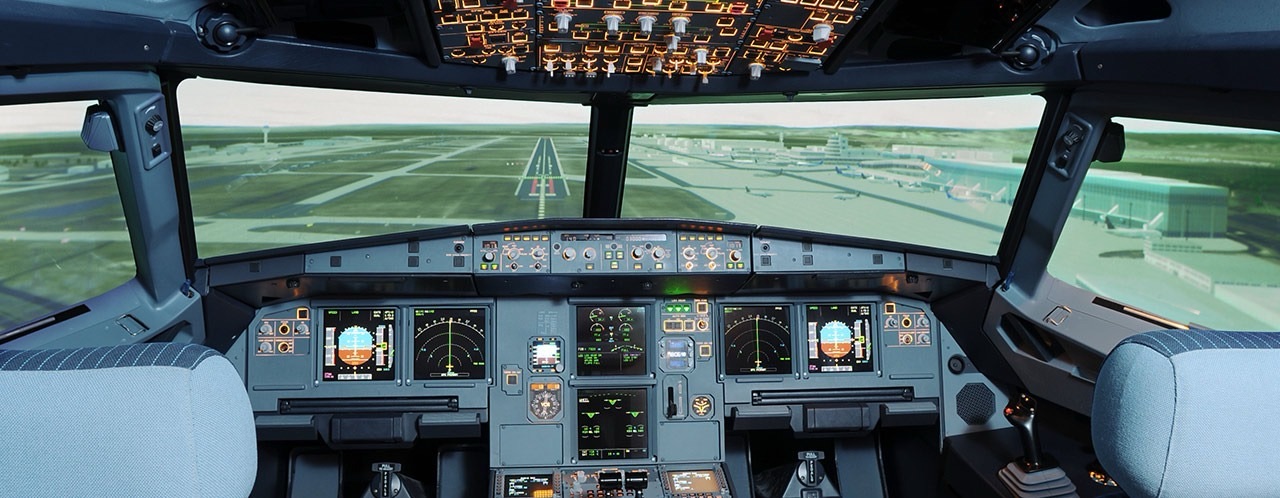
The Traffic Collision Avoidance System (TCAS) installed on the Airbus A320 family is a critical airborne safety system designed to prevent mid-air collisions. It operates independently of Air Traffic Control (ATC) and ground-based surveillance, providing flight crews with timely traffic awareness and, when necessary, vertical avoidance commands. On the A320, TCAS is fully integrated into the aircraft’s avionics and display philosophy, ensuring that collision avoidance guidance is presented clearly, intuitively, and in accordance with Airbus operational principles.
The A320 is equipped with TCAS II Version 7.1, which complies with international standards defined by ICAO and is mandated for commercial transport aircraft worldwide. TCAS functions as a last line of defense against airborne collision risks, supplementing but never replacing ATC separation services or pilot see-and-avoid responsibilities.
System Operating Principle
TCAS operates using active surveillance. The system transmits interrogation signals at 1030 MHz through directional antennas mounted on the top and bottom of the fuselage. Nearby aircraft equipped with Mode C or Mode S transponders respond at 1090 MHz, allowing TCAS to determine their relative bearing, range, altitude, and vertical speed. Using this data, the TCAS computer continuously predicts future flight paths and calculates the Closest Point of Approach (CPA).
Unlike radar systems, TCAS does not display all traffic equally. Instead, it prioritizes aircraft that pose a potential collision threat based on closure rate and vertical separation. This predictive logic allows the system to issue alerts with sufficient time for pilot response while minimizing nuisance warnings.
TCAS Equipment on the A320
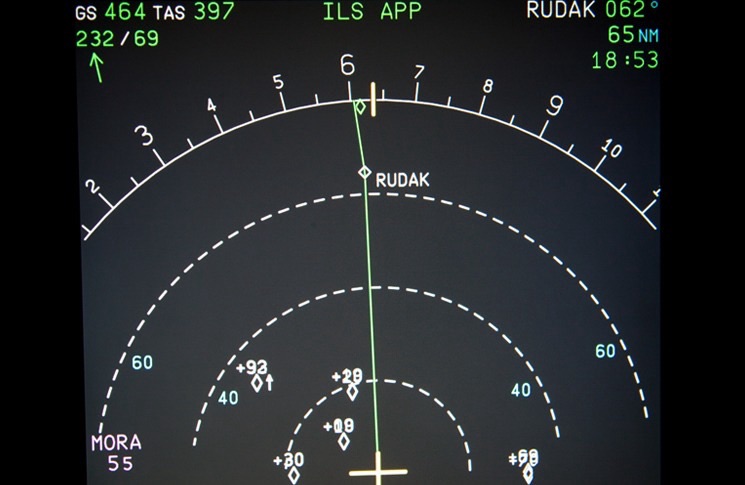
The TCAS installation on the A320 consists of a TCAS computer, directional antennas, and interfaces with the aircraft’s avionics and warning systems. Traffic information is displayed on the Navigation Display (ND), while Resolution Advisory guidance is shown on the Primary Flight Display (PFD). Aural alerts are provided through the cockpit loudspeaker system.
Integration with the flight deck architecture developed by Airbus ensures consistency with the Airbus philosophy of crew workload reduction and intuitive human-machine interaction. TCAS logic is independent from the flight control computers, meaning that even in degraded flight control laws, TCAS advisories remain available.
Traffic Advisories (TA)
A Traffic Advisory (TA) is issued when another aircraft is predicted to enter a defined proximity zone that could become hazardous if no action is taken. The purpose of a TA is to alert the crew to the presence of conflicting traffic and prompt a visual scan outside the cockpit.
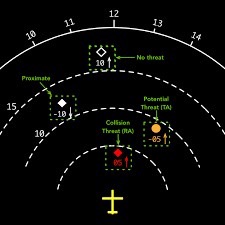
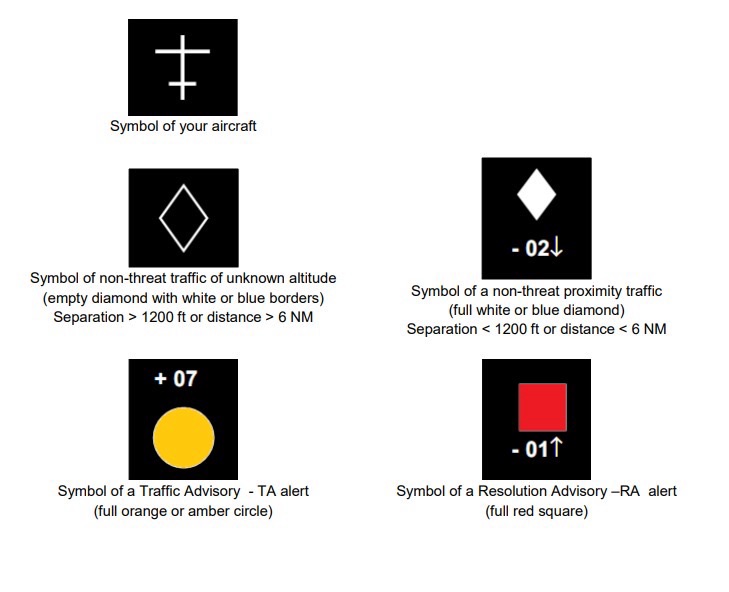
When a TA is triggered, the crew hears the aural warning “Traffic, Traffic”. On the Navigation Display, the intruding aircraft symbol changes to amber, and its relative altitude and climb or descent trend are shown. No vertical maneuver command is provided at this stage. The crew is expected to visually acquire the traffic, maintain situational awareness, and be prepared to respond immediately should a Resolution Advisory follow.
Typically, a TA occurs approximately 20 to 48 seconds before the predicted Closest Point of Approach, depending on altitude and closure rate.
Resolution Advisories (RA)
A Resolution Advisory (RA) is generated when TCAS determines that vertical separation will be insufficient unless immediate corrective action is taken. RAs provide mandatory vertical guidance to either increase or maintain separation from the conflicting aircraft. Importantly, TCAS never commands horizontal maneuvers.
On the A320, an RA is accompanied by a clear aural command such as “Climb,” “Descend,” “Adjust Vertical Speed,” or “Maintain Vertical Speed.” Simultaneously, the PFD vertical speed scale displays green “fly-to” areas and red “avoid” areas. Pilots are required to maneuver the aircraft smoothly to keep the vertical speed needle within the green band while avoiding the red zones.
Initial RAs are typically generated around 15 to 35 seconds before CPA. If the situation evolves, TCAS may issue strengthening or reversal commands to ensure adequate separation.
Airbus Crew Response Philosophy
Airbus procedures are explicit regarding TCAS Resolution Advisories. When an RA is issued, it has absolute priority over ATC instructions, flight plan constraints, and standard operating procedures. Even if an ATC clearance directly contradicts the RA, the crew must follow the TCAS command without delay.
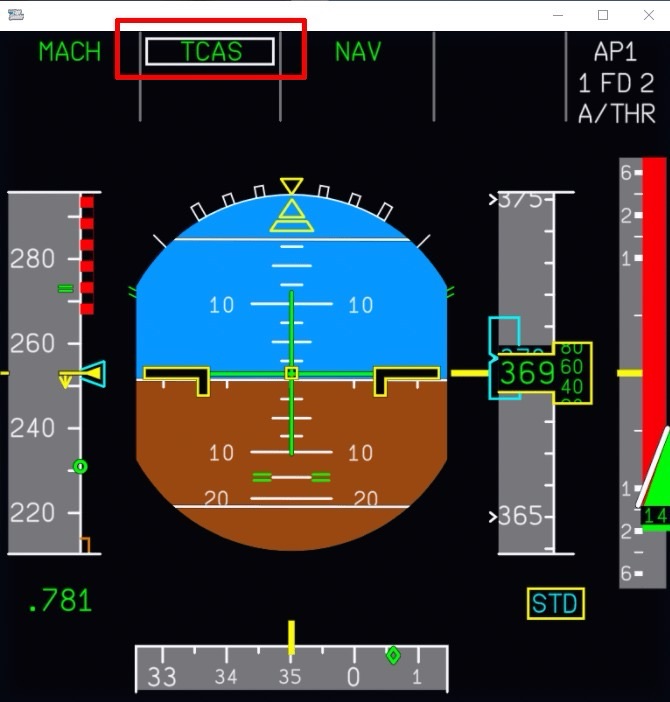
The correct response is to smoothly adjust pitch to comply with the RA guidance, avoiding abrupt control inputs or excessive deviations beyond the green band. The autopilot may remain engaged during the maneuver if it responds correctly to pilot inputs; however, the crew remains fully responsible for ensuring compliance with the advisory.
Once the conflict is resolved, TCAS announces “Clear of Conflict.” The crew should then promptly but smoothly return to the previously assigned altitude or flight path and inform ATC of the deviation caused by the TCAS RA.
RA Coordination Between Aircraft
One of the most important safety features of TCAS II is automatic coordination. When both aircraft involved in a conflict are TCAS II-equipped and operating in Mode S, their systems exchange coordination messages. This ensures that one aircraft receives a climb command while the other receives a complementary descent command, preventing both aircraft from maneuvering in the same vertical direction.
This coordination occurs automatically and requires no pilot action. It significantly reduces the risk of ineffective or opposing maneuvers during high-workload conflict situations.
Display Philosophy on the A320
The Airbus A320 presents TCAS information in a clear and standardized manner. On the Navigation Display, traffic symbols include relative altitude tags (in hundreds of feet) and trend arrows indicating climb or descent. During a TA or RA, the most threatening traffic is emphasized to draw immediate attention.
During an RA, the Primary Flight Display becomes the primary reference. The vertical speed scale provides direct, intuitive guidance, allowing pilots to respond instinctively rather than interpreting complex instructions. This presentation aligns with Airbus’s emphasis on minimizing reaction time and reducing cognitive workload.
System Limitations
Despite its effectiveness, TCAS has several inherent limitations that pilots must understand. TCAS can only detect aircraft equipped with operating transponders; it provides no protection against non-transponder traffic such as some light aircraft or unmanned aerial vehicles. TCAS also does not consider terrain, obstacles, or airspace constraints when issuing advisories.
Additionally, TCAS provides no horizontal avoidance guidance and is not intended to be used for routine separation or navigation. Certain scenarios, such as close formation flying or high-density terminal airspace, may reduce the accuracy of advisories or increase nuisance alerts.
Conclusion
The Traffic Collision Avoidance System on the Airbus A320 represents one of the most significant advancements in modern aviation safety. By independently monitoring surrounding traffic, predicting collision risks, and issuing coordinated vertical avoidance commands, TCAS provides flight crews with a powerful last-resort defense against mid-air collisions. When understood and applied correctly in accordance with Airbus procedures, TCAS enhances situational awareness, supports timely decision-making, and plays a vital role in maintaining the exceptionally high safety standards of commercial air transport.
If you want, I can tighten this for exam answers, align it line-by-line with FCOM wording, or add numerical thresholds and a limitation table for teaching purposes.
For all aviation-related guidance (DGCA ground classes, pilot training, cabin crew training)
Contact us https://contrail.in/
phone numbers +91 78457 69399