

Airbus Electronic Rudder Control System (E-Rudder)

Introduction
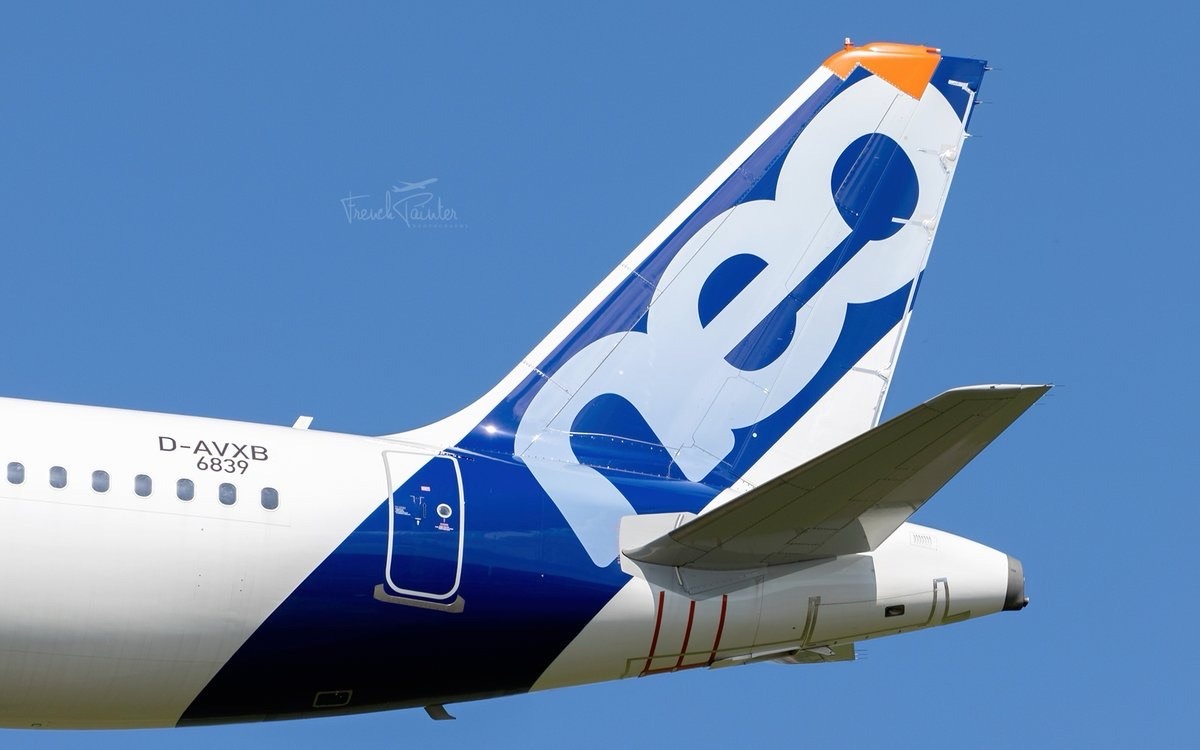
The Airbus Electronic Rudder Control System (E-Rudder) is an integral part of the fly-by-wire flight control architecture on the A320 family. The system provides yaw control through electrically signaled pilot inputs, computer-generated control laws, and hydraulically actuated rudder surfaces. Unlike conventional mechanically linked rudder systems, the Airbus E-Rudder incorporates automatic yaw damping, turn coordination, asymmetric thrust compensation, and structural load protection. These functions are continuously managed by the flight control computers to ensure safe and predictable handling across the aircraft’s entire operating envelope.
System Architecture and Numerical Overview
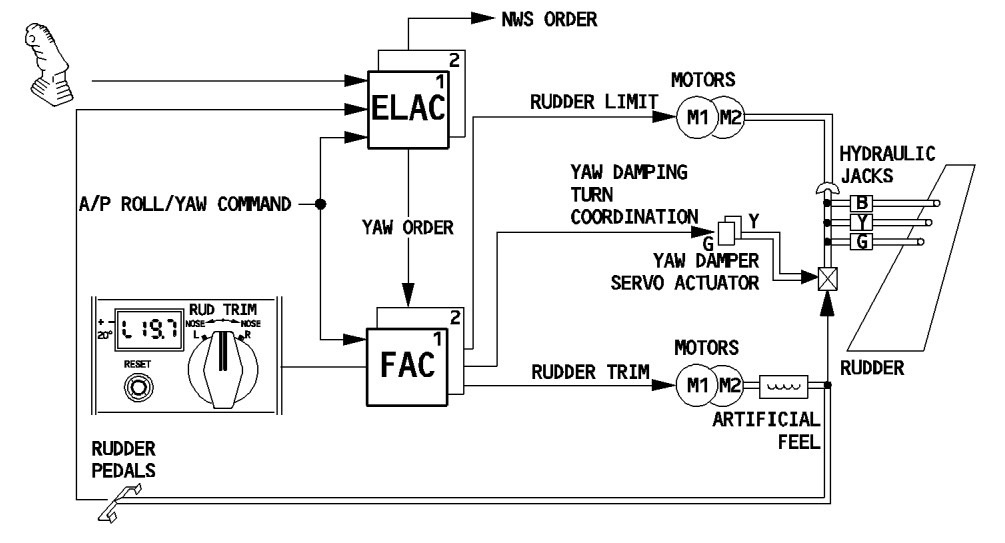
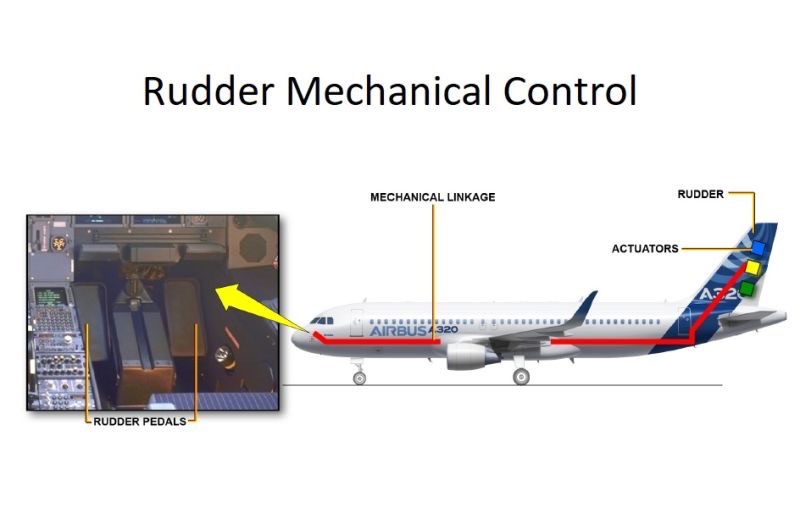
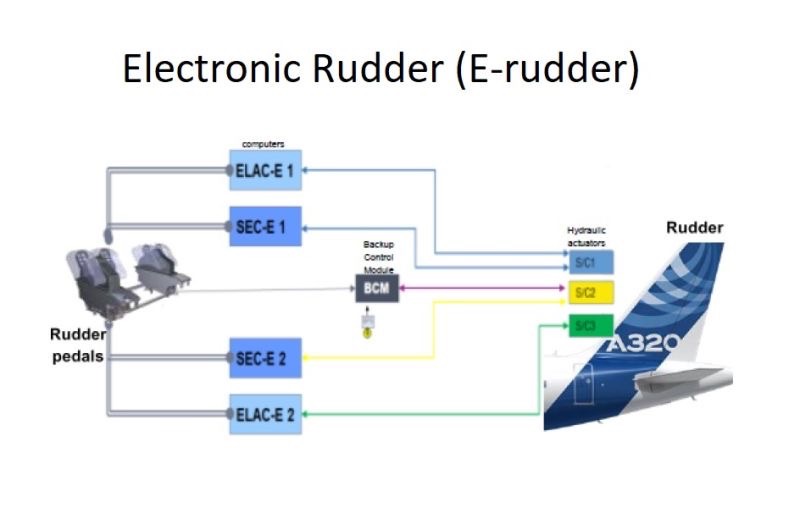
Pilot rudder pedal inputs are transmitted electrically to the Flight Control Primary Computers (FCPCs). The commanded rudder deflection is then sent to three independent hydraulic rudder actuators, powered by the Green, Blue, and Yellow hydraulic systems. This triple-hydraulic architecture provides full rudder authority following a single hydraulic system failure.
The rudder surface has a maximum physical deflection of approximately ±30 degrees. However, this full deflection is only available at low airspeeds. At higher airspeeds, available rudder travel is progressively limited by the control laws to protect the vertical stabilizer from excessive aerodynamic loads.
Rudder Pedal Input and Speed Scheduling
Rudder pedal authority on Airbus aircraft is airspeed-dependent. At low speeds, such as during takeoff and landing, the system allows large rudder deflections to ensure sufficient yaw control, particularly during engine-out scenarios.
Below approximately 160 kt, near-maximum rudder deflection (up to ±30°) is available. As airspeed increases, rudder authority is progressively reduced. At cruise speeds, typically above 250 kt, maximum available rudder deflection is limited to approximately ±5 to ±7 degrees, depending on aircraft configuration and flight conditions.
This speed-based scheduling ensures that large pedal inputs at high speed do not result in excessive side loads on the vertical stabilizer.
Control Laws and Yaw Rate Limitation
In Normal Law, rudder pedal input commands a yaw rate demand rather than a direct surface deflection. The system limits yaw rate to approximately 3 degrees per second during manual rudder input, preventing abrupt or aggressive yaw motions.
Sideslip angle is also monitored and limited to approximately ±5 degrees under normal operating conditions. If the aircraft approaches these limits, the system automatically reduces rudder deflection even if the pilot continues to apply pedal input.
In Alternate Law, some yaw protections may be reduced, but rudder travel limitation based on airspeed remains active to prevent structural overload. In Direct Law, rudder pedal input has a more linear relationship with rudder deflection, but maximum deflection limits are still enforced.
Yaw Damping and Turn Coordination
The E-Rudder system provides continuous yaw damping using inertial and air data inputs. Typical yaw damper corrections involve rudder movements of less than ±2 degrees, applied rapidly and symmetrically to counter gust-induced yaw disturbances.
During coordinated turns, the system automatically applies rudder to minimize sideslip, maintaining near-zero sideslip angle without pilot input. This coordination remains active from shortly after liftoff through approach, except during certain degraded law conditions.
Engine-Out Compensation and Automatic Rudder Input
Following an engine failure, the E-Rudder system provides automatic yaw compensation. This compensation is gradually introduced to avoid abrupt yaw transients and is scaled with airspeed.
At low speeds, such as shortly after liftoff, the system can command rudder deflections of 10 to 12 degrees to counter asymmetric thrust. As airspeed increases, the required rudder deflection decreases due to increased aerodynamic effectiveness, and the system correspondingly reduces commanded deflection.
This automatic compensation significantly reduces pilot workload and helps maintain directional control during critical phases of flight.
Rudder Trim System and Numerical Limits
The rudder trim system provides a trim range of approximately ±25 degrees. Rudder trim is typically used following an engine failure to relieve sustained pedal forces during extended asymmetric flight.
Trim inputs are processed electronically and act as a bias within the control laws rather than mechanically repositioning the rudder pedals. Trim rate is limited to prevent abrupt changes in yaw, ensuring smooth aircraft response.
Structural Load Protection and Vertical Stabilizer Limits
One of the primary objectives of the Airbus E-Rudder system is to prevent excessive structural loads on the vertical stabilizer. The system limits rudder deflection at high dynamic pressures to ensure that lateral loads remain within certified limits.
At speeds above Vmo/Mmo, rudder input authority is severely restricted, with available deflection limited to only a few degrees. This protection remains active regardless of pilot input and cannot be overridden.
The system also prevents rapid rudder reversals at high speed, further reducing the risk of structural overstress.
Failure Modes and Redundancy
The rudder system remains fully operational following a single hydraulic system failure. With two hydraulic systems available, full rudder authority is retained. In the unlikely event of multiple failures, rudder authority may be reduced, but basic yaw control is preserved.
Even in degraded modes, the system ensures that rudder deflections remain within safe limits, and uncontrollable yaw motions are prevented.
Operational Philosophy and Pilot Awareness
Airbus philosophy encourages minimal rudder use at high speed. Pilots are trained to use rudder primarily during takeoff, landing, crosswind operations, and engine-out situations. Aggressive rudder inputs at cruise speed are neither required nor effective due to built-in authority limitations.
The E-Rudder system is designed to assist the pilot while preventing hazardous control inputs, reflecting Airbus’ emphasis on workload reduction and structural protection.
Conclusion
The Airbus Electronic Rudder Control System combines pilot inputs with automatic yaw control, speed-dependent authority scheduling, and structural protections to deliver safe and predictable yaw handling. With maximum rudder deflection of approximately ±30 degrees at low speed, progressively reduced to a few degrees at cruise, and automatic engine-out compensation of up to approximately 10–12 degrees, the system ensures effective yaw control while protecting the airframe. The E-Rudder system exemplifies Airbus’ fly-by-wire philosophy by blending pilot authority with intelligent automation to enhance both safety and handling quality.
For all aviation-related guidance (DGCA ground classes, pilot training, cabin crew training)
Contact us https://contrail.in/
phone numbers +91 78457 69399