
Airbus A320 Flight Control Systems – A Technical Overview

Introduction
The Airbus A320 introduced a revolutionary approach to aircraft handling with the adoption of full-authority digital fly-by-wire (FBW) flight controls. Unlike conventional mechanically linked systems, the A320 uses electronic signaling, flight control computers, and flight envelope protections to enhance safety, efficiency, and handling consistency. The philosophy behind Airbus flight controls is to assist the pilot, prevent unsafe aircraft states, and ensure predictable aircraft response throughout the flight envelope.
This article explains the architecture, control laws, pilot interfaces, protections, and operational philosophy of the A320 flight control system, as described in Airbus operational documentation.
Fly-By-Wire Concept and Architecture
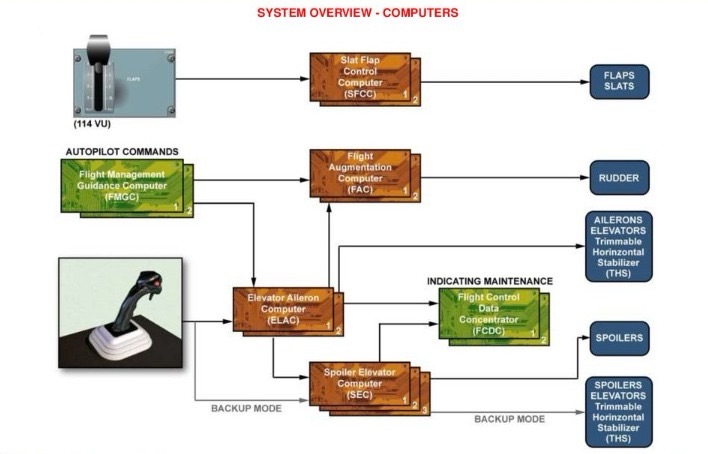
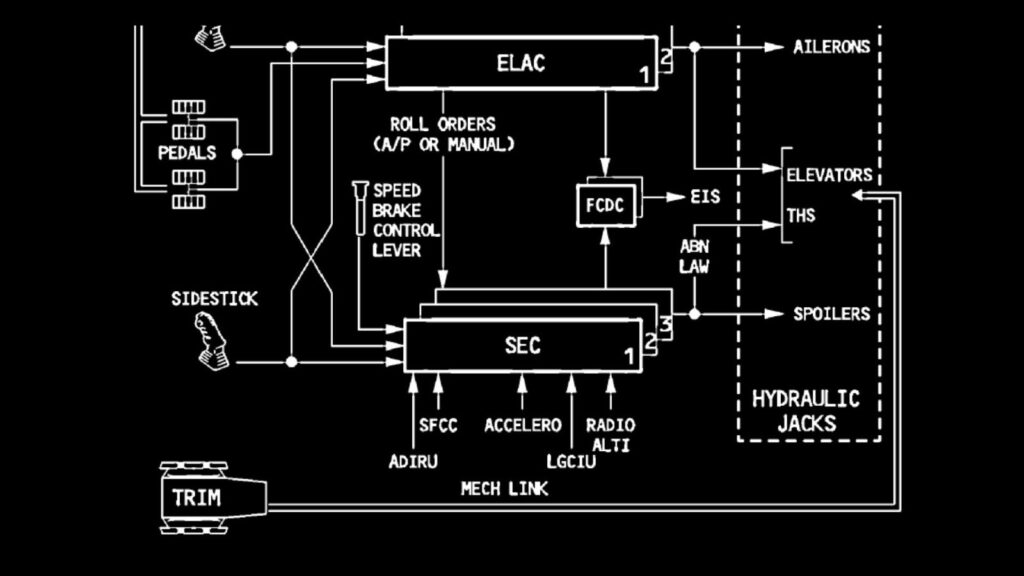
In the A320, pilot inputs from the sidestick controllers are converted into electrical signals, which are processed by a network of flight control computers. These computers then command hydraulically actuated control surfaces.
Key Characteristics:
· No direct mechanical linkage between pilot and control surfaces
· Electrical signal transmission with multiple redundancies
· Hydraulic actuation remains conventional
· Manual reversion is not provided; electrical control is always required
The system is designed with multiple independent computers and power sources, ensuring continued control even after multiple failures.
Primary Flight Control Computers
The A320 flight control system consists of seven main computers:
Flight Control Computers
· ELAC (Elevator Aileron Computers) – 2 units
o Control elevators and ailerons
o Provide pitch and roll control
· SEC (Spoiler Elevator Computers) – 3 units
o Control spoilers
o Provide backup pitch and roll control
· FAC (Flight Augmentation Computers) – 2 units
o Control yaw functions
o Provide rudder control, turn coordination, yaw damping, and envelope functions
Each computer continuously monitors itself and others, allowing automatic reconfiguration in case of failure.
Control Surfaces
Primary Control Surfaces:
· Elevators – Pitch control
· Ailerons – Roll control
· Rudder – Yaw control
Secondary Control Surfaces:
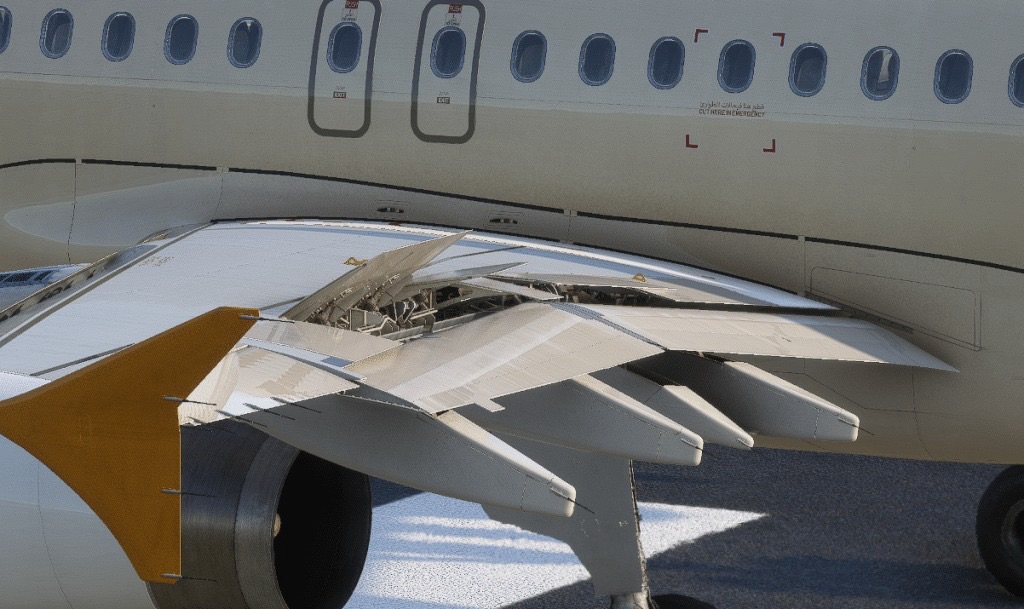
· Spoilers – Roll assistance, speed brake, ground lift dumping
· Trimmable Horizontal Stabilizer (THS) – Pitch trim
· Flaps and Slats – High-lift devices (controlled separately via SFCCs)
Under normal conditions, control authority is shared among multiple surfaces to optimize aerodynamic efficiency and load distribution.
Sidestick Controllers and Pilot Interface
The A320 uses sidestick controllers instead of traditional control columns.
Sidestick Characteristics:
· Spring-loaded, self-centering
· No mechanical feedback from control surfaces
· Inputs are rate-based, not surface-deflection based
· Independent left and right sidesticks
Importantly, sidesticks are not mechanically linked. Dual inputs result in algebraic summation, and a warning (“DUAL INPUT”) alerts the crew. Either pilot can press the sidestick priority takeover pushbutton to deactivate the other sidestick.
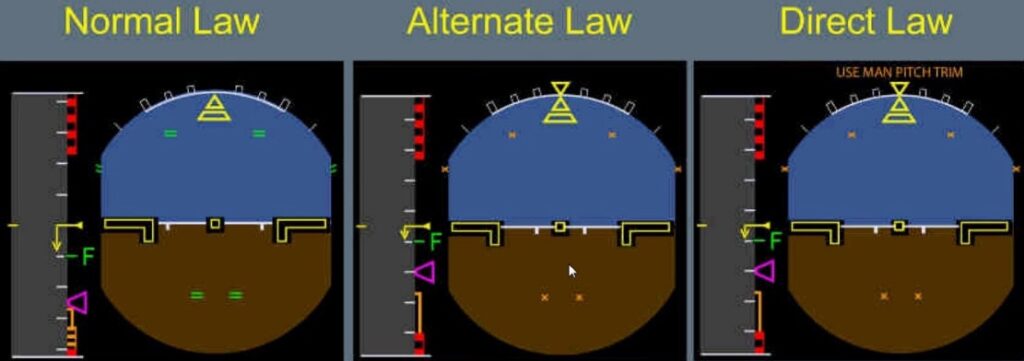
Flight Control Laws
The heart of the A320 FBW system is its control laws, which define how pilot inputs are interpreted.
Normal Law
Normal Law provides full flight envelope protection and is active during most phases of flight.
Pitch Control:
· Load factor demand (G-command)
· Automatic pitch trim
· Neutral stick maintains current flight path
Roll Control:
· Roll rate demand
· Automatic turn coordination
· Roll protection at high bank angles
Protections in Normal Law:
· Angle of Attack (α) Protection
· High Speed Protection
· Load Factor Limitation
· Pitch Attitude Protection
· Bank Angle Protection
These protections ensure the aircraft remains within certified aerodynamic limits, even during aggressive pilot inputs.
Alternate Law
Alternate Law is entered following certain system failures.
Characteristics:
· Reduced or removed envelope protections
· Pitch control may revert to load factor without full protections
· Roll control typically remains in direct mode
· Automatic trim may be retained or lost depending on failure
Airbus documentation distinguishes between Alternate Law with protections and Alternate Law without protections.
Direct Law
In Direct Law:
· Pilot inputs are directly proportional to control surface deflection
· No flight envelope protection
· No automatic trim (manual trim required)
· Similar handling to conventional aircraft
Direct Law is typically associated with landing gear extension following significant failures.
Mechanical Backup
Mechanical Backup allows limited control using:
· Rudder pedals
· Manual THS trim wheel
This mode is intended only to maintain aircraft attitude long enough to regain electrical control or stabilize the aircraft.
Flight Envelope Protections
One of the defining features of the A320 is its flight envelope protection system.
Angle of Attack Protection
Prevents aerodynamic stall by limiting maximum AoA. Even with full aft sidestick, the aircraft will not exceed the protected angle.
High Speed Protection
Automatically limits nose-down commands and may introduce pitch-up input if VMO/MMO is exceeded.
Load Factor Protection
Limits structural loads by restricting G-forces.
Bank Angle Protection
Limits bank angle to approximately 67° in Normal Law.
These protections cannot be overridden in Normal Law, reflecting Airbus’ safety-first design philosophy.
Trimmable Horizontal Stabilizer (THS)
In Normal Law:
· THS is automatically controlled
· Pilot does not manually trim
· System optimizes pitch efficiency and reduces drag
In degraded laws:
· Manual trim may be required
· Trim wheel provides mechanical input to the THS
System Philosophy and Operational Considerations
Airbus flight control philosophy emphasizes:
· Flight path stability
· Workload reduction
· Error tolerance
· Predictable handling
Unlike conventional aircraft where pilots directly control surfaces, Airbus pilots command aircraft behavior, and the computers manage how that behavior is achieved.
Operationally, this requires pilots to:
· Trust the protections
· Understand control laws and reversion logic
· Recognize degraded modes through ECAM and flight mode annunciations
Conclusion
The Airbus A320 flight control system represents a fundamental shift in aircraft handling philosophy. Through fly-by-wire architecture, advanced control laws, and robust envelope protections, Airbus has created an aircraft that actively assists the pilot while maintaining strict safety margins.
A deep understanding of control laws, protections, and system behavior is essential for safe and effective operation. As emphasized throughout Airbus FCOM and FCTM guidance, pilots must not only know how the system works, but also why it behaves the way it does—especially during failures and abnormal situations.
For all aviation-related guidance (DGCA ground classes, pilot training, cabin crew training)
Contact us https://contrail.in/
phone numbers +91 78457 69399